MITRE ATT&CK and Automated Test Scenarios: Simulating Real-World Tactics
- MITRE ATT&CK
- Purple teaming
- Detection engineering
- Automation
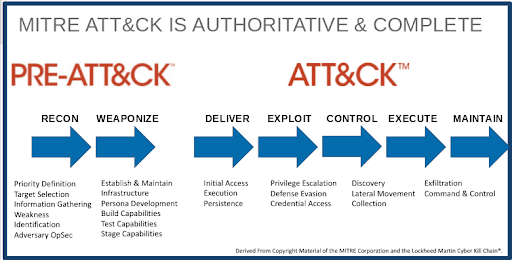
Attackers chain tactics, techniques and procedures together. Paired with automation, ATT&CK turns penetration testing into continuous, real-world simulation.
Introduction
Cybersecurity testing has long focused on detecting and patching vulnerabilities. While this remains critical, it only covers one part of the equation. Attackers rarely rely on a single vulnerability; instead, they chain together multiple tactics, techniques, and procedures (TTPs) to achieve their goals.
This is where MITRE ATT&CK stands out. It is not just a reference but a living knowledge base that maps out adversary behaviours observed in the wild. When paired with automation, ATT&CK can transform penetration testing from a one-off exercise into continuous, real-world simulation.
What is MITRE ATT&CK?
MITRE ATT&CK (Adversarial Tactics, Techniques & Common Knowledge) is a globally recognised framework cataloguing real-world adversary behaviour.
- Tactics
- The “why” of an attack — high-level objectives such as Initial Access, Persistence, or Exfiltration.
- Techniques
- The “how” — specific methods used to achieve a tactic, such as Spearphishing Attachment or Credential Dumping.
- Sub-techniques and examples
- More granular methods attackers employ.
The framework is continuously updated, making it one of the most reliable ways to understand, test, and defend against evolving threats.
Why use ATT&CK in security testing?
Traditional vulnerability scans tell us where systems may be weak. ATT&CK-based testing goes a step further by asking whether adversary behaviours can be detected, whether defenders can respond quickly enough, and where the detection blind spots are.
- Realistic simulation
- Tests mirror actual attack patterns observed in the wild.
- Detection validation
- Measures how well defences — SOC, SIEM, EDR — detect adversary techniques.
- Gap analysis
- Identifies blind spots across logs, monitoring, and response processes.
- Standardisation
- Provides a globally recognised framework for reporting and benchmarking.
Automated testing with ATT&CK scenarios
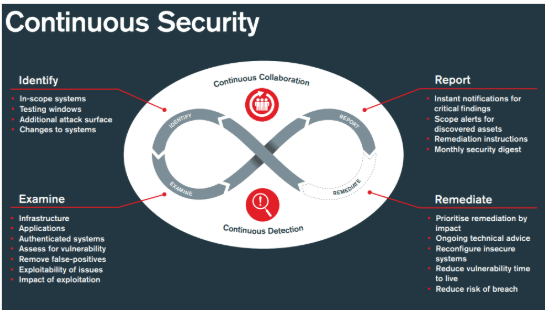
Automation brings repeatability and scalability to ATT&CK-based simulations. Here's how it works:
- Playbooks
- Predefined test sequences that replicate adversary techniques, for example credential dumping followed by lateral movement.
- Mapping
- Each result is tied to an ATT&CK ID such as T1003.001 (LSASS Memory), making reporting precise.
- Repeatability
- Automated jobs rerun at defined intervals to validate defences continuously.
Purple teaming with ATT&CK
One of ATT&CK's strongest use cases is in purple team exercises:
- Red team
- Simulates adversary TTPs using ATT&CK as a reference.
- Blue team
- Monitors, detects, and responds to these simulated attacks.
- Purple team
- Facilitates collaboration, ensuring insights lead to measurable improvements.
This alignment helps organizations evolve from simple detection toward resilience and response readiness.
Practical implementation tips
- Start small
- Pick one tactic — say Initial Access — and test two or three techniques.
- Measure detection
- Record whether alerts were triggered in SIEM or EDR.
- Automate iteration
- Schedule recurring tests for critical techniques.
- Integrate reporting
- Map test outcomes directly into risk dashboards.
An automation tool such as PentestBX can run ATT&CK playbooks and map results to reports, giving both executives and SOC analysts actionable insights — from selecting an adversary or ability through to the full list of attack simulations.
Conclusion
MITRE ATT&CK is more than a matrix — it's a lens through which organizations can validate their defences against real adversary behaviour. When automated, ATT&CK scenarios enable continuous validation, helping security teams uncover blind spots before attackers exploit them.