Beyond Scanning: Stepping into the Era of Adversarial Exposure Validation (AEV) with PentestBX
- AEV
- NIS2
- GDPR
- Adversary emulation

Traditional vulnerability scanning cannot keep pace with the velocity of cyber threats. AEV continuously validates how easily your vulnerabilities can actually be exploited.
We live in an age where traditional vulnerability scanning methods simply cannot keep pace with the velocity of cyber threats. Organizations across Europe, particularly with the impending NIS2 Directive and existing GDPR obligations, must measure their security posture against real-world attack risk.
PentestBX is an Adversarial Exposure Validation (AEV) platform designed to meet this exact need, continuously validating how easily your vulnerabilities can be exploited by an attacker.
1. What is AEV and how does it differ from traditional pentesting?
Traditional penetration tests are manual, time-consuming processes that provide a security snapshot at a single point in time. Vulnerability scanners list potential issues but fail to tell you whether an attacker can chain these vulnerabilities together to reach a critical target.
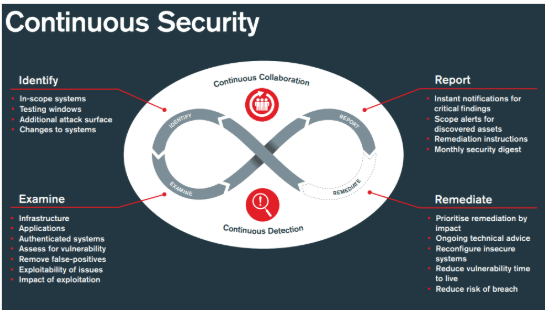
Adversarial Exposure Validation fills this gap. AEV continuously monitors an organization's entire attack surface and acts like a real threat actor — adversary emulation — finding and validating vulnerabilities and confirming how close these attack chains get to business-critical assets. PentestBX leverages the Penetration Testing as-a-Service (PTaaS) model to turn AEV into an automated and continuous process.
2. The three core capabilities of the PentestBX AEV framework
PentestBX combines the three main components required for effective AEV into a single platform, practically and cost-effectively enhancing your cyber resilience.
A. Continuous Attack Surface Management
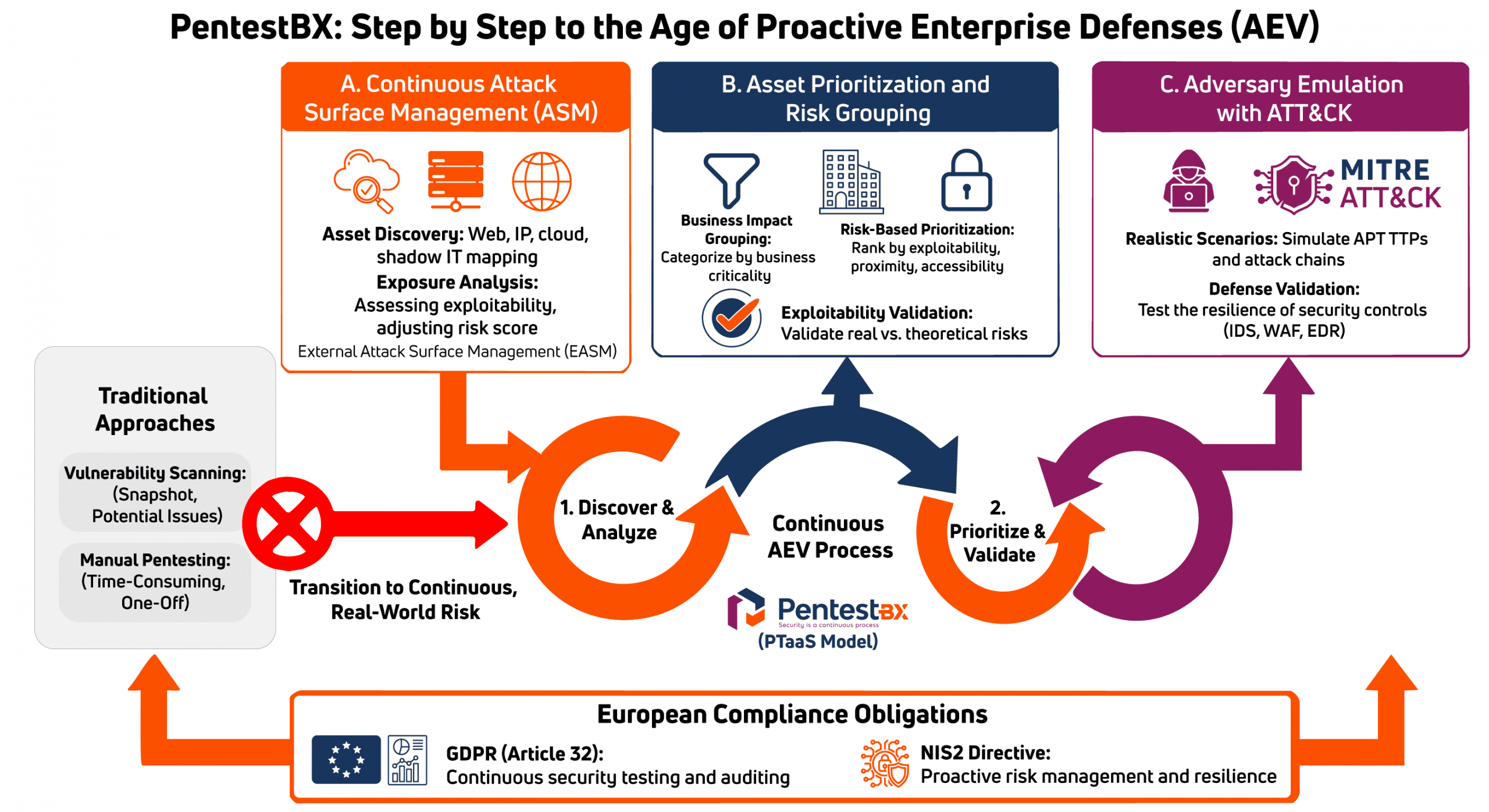
An attacker's first move is discovering weak points. Through its External Attack Surface Management (EASM) capabilities, PentestBX provides:
- Asset Discovery
- Continuously maps all web assets, IP addresses, cloud resources, and shadow IT associated with your organization and exposed to the cyber domain.
- Exposure Analysis
- Analyses the potential vulnerabilities and misconfigurations of each asset on your attack surface, determining how easily it can be exploited. This adjusts risk scoring based on true threat potential.
B. Asset prioritisation and risk grouping
A critical phase of AEV is focusing security teams' efforts on the highest-risk, business-critical assets. PentestBX goes beyond simply finding flaws by providing:
- Business Impact Grouping
- Categorises IT assets — web servers, APIs, databases — based on their criticality to business processes, so remediation effort prioritises the company's most valuable assets.
- Risk-Based Prioritisation
- Instead of relying solely on CVSS scores, PentestBX rates vulnerabilities by exploitability, proximity to sensitive data, and network accessibility — so teams focus on verified risks that threaten business continuity, not hundreds of generic alerts.
- Exploitability Validation
- Safely and controllably verifies whether vulnerabilities are truly exploitable, ensuring security teams address practical and actual risks rather than theoretical ones.
C. Adversary emulation with ATT&CKLab
The ATT&CKLab module elevates the platform's AEV capability.
- Realistic Scenarios
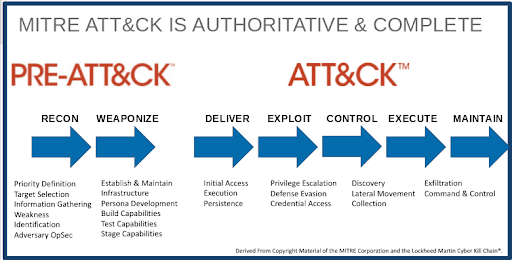
- Leveraging the MITRE ATT&CK framework, it automatically simulates comprehensive attack chains that mimic the tactics, techniques, and procedures used by known APT groups.
- Defense Validation
- Measures how resilient your security controls (IDS/IPS, WAF, EDR) are against these realistic attacks, clearly indicating whether the weakness lies in the vulnerability itself or in the failure of a defensive control.
3. European compliance obligations and PentestBX
Proving your security in the Western European market hinges on regulatory compliance:
- GDPR (Article 32)
- Provides the capability to continuously demonstrate that an appropriate level of security is maintained through regular testing and auditing, relative to the risks of data processing.
- NIS2 Directive
- Mandates risk management and resilience of network and information systems. AEV automatically fulfils a core requirement of NIS2 by proactively and continuously identifying risks.
Conclusion
In a world where traditional pentest reports are no longer sufficient, PentestBX offers continuous, automated, and adversary-focused security validation. Managed Security Service Providers who integrate PentestBX into their portfolio gain the power to prove to their clients that they are not just “compliant”, but resilient against real cyberattacks — while simultaneously creating a recurring and more profitable revenue stream for themselves.